
In our guide to planning and budgeting a lab fit-out, we noted that fume hoods are often the most expensive line item, and that the choice between ducted vs ductless fume hoods should depend on the chemicals being handled, not on which option looks cheaper. This article looks at that decision in more detail: how each type works, which chemicals each can handle safely, what they cost to run, what they need from your building, and what happens when the wrong type is chosen.
How Each Type Works
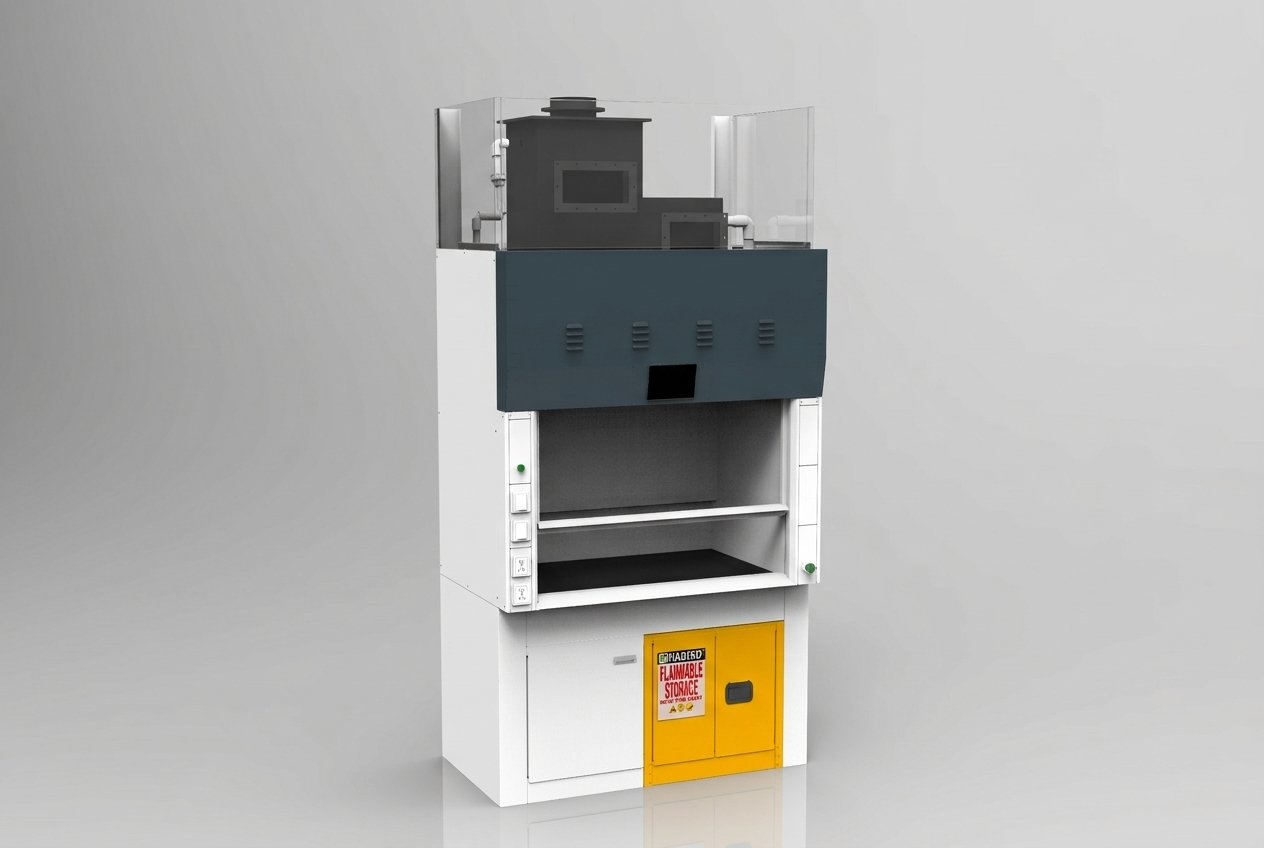
Ducted fume hoods send contaminated air through ductwork and release it outside the building, so they can handle a wide range of chemicals and quantities. Ductless fume hoods (also called filtered or recirculating hoods) pass air through a carbon filter, sometimes with a HEPA filter added, and return the cleaned air to the room. With no ductwork, they are easier to install and can often be moved.
In short, a ducted hood removes contaminants from the building, while a ductless hood traps them in a filter. Every other difference follows from that. See the Nadiso fume hood series.
Chemical Compatibility: The Deciding Factor
When Ducted Is Required
- Your lab uses a wide or changing range of chemicals
- You handle large volumes or work with chemicals for long periods
- You work with highly toxic, carcinogenic, or unknown substances
- Processes generate a lot of heat or vapor, such as acid digestion or evaporation
- You use perchloric acid, which needs a dedicated ducted hood with a washdown system because its vapors can form explosive deposits
- You need flexibility for future research that may introduce new chemicals
When Ductless Can Work
- You use a short list of known chemicals confirmed compatible with the filter
- Quantities are small and the hood is used lightly or occasionally
- The work is routine and unlikely to change, such as a fixed teaching procedure
- Ductwork is not possible or costs too much, for example in a rented space or an older building
A reliable supplier should check whether its filter can handle your specific chemicals and quantities. If a supplier can’t do that, treat it as a warning sign. A common mix-up: a ductless fume hood is not a biosafety cabinet. Fume hoods handle chemical vapors, while biosafety cabinets protect against biological agents (see what is a biosafety cabinet).
Operating Costs
Over a hood’s lifetime, running costs often matter more than the purchase price. Ducted hoods cost more to install because they need ductwork, an exhaust fan, and a roof opening. They also cost more to run, because they constantly pull out air the building has already cooled. In Indonesia’s tropical climate, where air conditioning runs most of the year, that adds up fast, especially with several hoods running all day.
Ductless hoods cost less to install and use far less energy, because the cooled air stays in the room. Their main ongoing cost is replacing carbon filters, and how often depends on how heavily the hood is used. A full filter can let contaminants back into the room, so many units include a saturation alarm.
| Factor | Ducted | Ductless |
|---|---|---|
| Installation cost | High (ductwork, fan, roof work) | Low |
| Energy cost | High (exhausts conditioned air) | Low |
| Recurring cost | Fan and duct maintenance | Filter replacement and monitoring |
| Chemical flexibility | Broad | Limited to filter-compatible chemicals |
| Mobility | Fixed | Often movable |
| Best fit | Research, heavy or varied chemical use | Light, routine, known chemical use |
HVAC and Building Requirements
Ducted hoods depend on the building. Before choosing one, check:
- Exhaust route: can ductwork reach the roof or an outside wall?
- Makeup air: can the HVAC system replace the air being exhausted? If not, doors become hard to open and the hood won’t contain fumes properly.
- Air balance: supply air, room pressure, and exhaust must be designed together.
- Exhaust discharge: exhaust must be released away from the building’s air intakes.
In older buildings, HVAC upgrades can cost as much as the hoods themselves, so do a site survey early. Ductless hoods need much less from the building: a power supply, enough clearance, and decent general ventilation. They don’t replace proper room ventilation.
The Risks of Choosing the Wrong Type
Choosing ductless when ducted is needed is the more dangerous mistake. If the filter can’t capture a chemical, or fills up unnoticed, vapors go straight back into the room, and the risk rises when new chemicals come into use without rechecking filter compatibility. Choosing ducted when ductless would be enough is mostly a cost problem: the lab pays for ductwork, HVAC upgrades, and energy it doesn’t need.
Installing ducted hoods without checking the building leads to poor containment: a hood can look fine and still fail to protect users if the exhaust is undersized or makeup air is missing. Failing audits: hoods that don’t match documented chemical use, or have no performance test records, can be flagged in safety audits. For general guidance, see the OSHA laboratory safety resources, and for upkeep our fume hood maintenance guide.
A Quick Decision Checklist
- Which chemicals will be used in the hood, in what amounts, and how often?
- Is that list fixed, or likely to change in the next few years?
- Are any of the chemicals highly toxic, carcinogenic, or perchloric acid?
- Is there a practical exhaust route, and can the HVAC system supply enough makeup air?
- What is the total cost over 5 to 10 years, including energy and filter replacement?
- Who will monitor filter saturation and maintenance schedules?
If your answers point to broad, heavy, or changing chemical use, a ducted hood is almost always right. If they point to light, routine use of a short list of known chemicals where ductwork is impractical, a ductless hood may be a sensible and economical option.
Get the Right Fume Hood from the Start
A fume hood is safety equipment first, so the right type depends on the work done inside it. Since 1997, Nadiso has helped government, education, and industrial clients choose and install fume hoods, from selection through handover. Not sure which type fits your lab, or whether your building can support a ducted system? Contact Nadiso for a free consultation. We’ll review your chemicals and site conditions and recommend the right solution.
Read also: The Complete Guide to Maintenance your Fume Hood · How Regular Do We Have to Maintain a Fume Hood?